

Standing out

How organizations cope with complexity through expanding the scope of corporate communication

Speech delivered at the European Communication Summit in Brussels on 6 July 2012

About strategy

Strategy requires foresight, decisiveness, and persuasion. That’s why most of what is labeled strategy is no more than an action plan.

I have been dedicated to strategy since the early nineties. As university student, I was fascinated by nation building strategies. As assistant professor, I explored strategies how to prevent and solve social and political conflicts resulting from such processes. During the last twelve years I have been advising companies and institutions on finding and communicating strategies. Since 2009, I have been teaching the subject at university. It intrigues me how many strategists miss the point. One example:

Missing the point

What do „Capital“ by Karl Marx and „The New Normal“ by McKinsey have in common? Good analysis, but no solution to the real problem.

Marxism seems to have fallen out of time irreversibly. McKinseyism has not. Nevertheless, both have something in common: good analysis, bad proposal. Just after the collapse of Lehman Brothers, the global managing director of McKinsey proposed a fix to the complexity of the business world after the end of Wall Street’s unrivaled global hegemony. Bottom line: Companies just need to analyze larger quantities of more kinds of information at higher frequency. Harvesting the Big Data ocean, corporations will not only survive uncertainty, but flourish through making use of opportunities their competitors are not even aware of. In other words: You just need better technology to reduce complexity.

Complexity

Leading neuroscientists like António Damásio or Gerald Hüther strongly disagree. They have a different understanding of why we are struggling with complexity and how we can handle it.

Data overflow

We face complexity whenever it is impossible to consider everything we would need to know for basing a far-reaching decision on facts.

According to system theory, we deal with complexity whenever we find it impossible to consider everything we would need to know for basing a far-reaching decision on facts. Every second, our senses deliver 100 Gigabits of information to the brain. The human working memory is able to process a volume of 160 Bits per second. This means: the RAM of our brain uses only a tiny fraction of the incoming data.

Irrationality

Decision-making is influenced by factors we are not aware of, e.g. codes resulting from family tradition and social learning.

The information filtering process is part of our genetic program to survive dangerous situations. Which data are selected for decision-making depends on factors, most of which we are not conscious about: our current state of mind and body, knowledge, own and mediated experiences or family traumata. e.g., one of your ancestors was bitten by a snake and now you have a snake phobia, although you never made a bad experience yourself. The challenge of coping with complexity is as old as mankind. It was complexity that made our ancestors invent deities to explain fate and natural phenomena. So far, scientific progress has not solved the issue. It did the opposite.

Volatility

Globalization has intertwined players, activities and impacts. Digitalization has increased the speed of action and the level of unpredictability.

Today, we are living in a global village and do business on global markets. The BRIC countries are approaching eye level with the OECD economies. Their governments are bailing out Western banks and countries, their businesses have taken an active role on the M&A market. And not only the number of players has been growing constantly. Digitalization still continues to speed up the global economy in a way, that already ousted human traders from large parts of stock exchange.

Change

To cope with unprecedented volatility, companies and societies need to increase their readiness for change. This requires the application of three guiding principles:

Flexibility

The fundamental prerequisite of a transformational organization is its willingness to adapt to changes in the environment.

The first is flexibility. Operating in an environment where change is the only constant, organizations must be able to adapt. They need to develop the ability to react to unforeseen developments. And they need to do this more quickly and effective than competitors or challengers of any kind. More than anything else, this requires a positive attitude towards change.

Awareness

The second premise for becoming change-ready is being attentive of events and situations that bring along new possibilities.

The second key success factor is awareness. Transformational organizations not only embrace changes they cannot avoid. They are open for change in an active way. They are on the lookout for signs of change to make use of any opportunities that might be related to it. Samuel Reshevsky, demonstrated this high level of awareness at the age of eight. In 1920, he defeated several chess masters at a simultaneous exhibition in Paris.

Resilience

Who tries something new might fail. Therefore, readiness for change also includes the ability to regain shape after failure.

Innovation always bears the risk of failure. It is one thing to take a risk. The greater challenge is to deal with painful failure. This is a matter of leadership culture. What happens to the courageous risk-takers who fail? Who gets promoted: the flawless cautious or the innovator who goes for bigger gains and sometimes loses? The way an organization answers this question determines its ability to regain shape after catastrophic experiences.

Leadership

Being flexible, aware and resilient cannot be ordered. Driving change is a matter of leadership. In an environment of growing complexity the main task of corporate leaders is managing uncertainty. What does it take to fulfill this task?

Conviction

Leadership requires the skill to convince others to do what seems right without having reliable information about the future oneself.

More often than not, change is uncomfortable. It means to stop doing what we are used to do. We have to acquire new skills and explore ways, we have never walked before. Change is always related to risk of failure. In a complex environment, leadership requires the skill to convince others to do what seems right – without knowing oneself how the future will look like.

Direction

In times of uncertainty, a leader needs the courage to establish a clear common goal, if he wants the organization to keep moving.

Therefore, in times of uncertainty, a leader needs the courage to establish a clear common goal, if he wants the organization to keep moving. Let’s take Samsung as an example: In 1993, the company was focused on producing massive quantities of low-quality goods and facing insolvency. Lee Kun Hee, then CEO of Samsung Group, changed course dramatically. He reduced the workforce by a third and asked the remaining employees to „Change everything except your wife and kids“. The new vision was to focus on high quality and profitability in order to become a premium brand. Creating better products than anybody else became the new guiding principle. The shift is now widely considered a success. Samsung leads the world market in 19 industry segments and already ranks #17 among Interbrand’s Best Global Brands.

Empowerment

Unleashing the full problem-solving potential of the organization requires to enable its associates to make and execute their own decisions.

The third requirement for leadership in the era of hypercomplexity is empowerment. Probably all of you will know the famous quote by Saint-Exupery: „If you want to build a ship, don’t drum up people to collect wood and don’t assign them tasks and work, but rather teach them to long for the endless immensity of the sea.“ This is exactly what empowerment is about. In times when organizations need to cope with unexpected events and situations every day, decisions need to be taken all the time and quickly. Employees need to be encouraged to take more responsibility.  Managers have to provide the target coordinate and a detailed topographical map, not only a sketch of the route they want their staff to take. Otherwise, employees need to turn back, once they find the proposed road blocked. There is hardly any large company that has given employees more autonomy and responsibility than Google. They have been applying the principles of empowerment throughout their organization. Just think of the 20 percent rule or the way project teams are initiated. This has immensely contributed to the success of Google.

Strategy

Those who don’t believe that empowerment also works in „normal“ companies fear the risk of chaos. But Fredmund Malik, currently the most prominent representative of the St. Gallen school of management, sees one way to cope with this problem: strategy. According to Malik, „Strategy is to do what’s right, when we don’t know how the future will be, but nevertheless need to act — having in mind that doing nothing is a kind of action.“ Unfortunately, the term strategy is prestigious but not clearly defined.
Or as Henry Mintzberg diagnosed: „The word strategy has been around for a long time. Managers now use it both freely and fondly. It is also considered to be the high point of managerial activity. […] business schools usually have as their final required capstone a course in strategic management. The word strategy is so influential. But what does it really mean?“ Let me introduce a very pragmatic approach. It is based on three key deliverables:

Vision

Strategy is the art of deducing from the future what needs to be done now.

First of all, developing a strategy needs a goal that is ambitious enough to require a strategy. Otherwise, a simple operational plan would do.
If such a goal is set, developing the strategy means moving backwards until it is clear, what needs to be done now. This includes immediate operations as well as creating potentials to enable further action on the way to realizing the current vision.

Anticipation

Strategic planning requires to think in constellations and to realize which of them promise greater success than others.

As said before, strategy is needed to deal with unavoidable lack of knowledge. Strategic decision-making is based on the principle of selection. Because we are unable to consider every possible influence factor, we have to make assumptions. Which factors seem to be more important than others? Which scenarios are possible? Which of them promises the greatest success? How likely is it to make this happen?

Engagement

Even the best strategy is worthless without the ability to win over others to realize the most promising constellation and make use of it.

Once the most promising constellation is identified, the difficult part of strategic management begins: creating a joint venture of interests between organizational leadership, employees and relevant stakeholders. All groups, whose cooperation is needed, have to be engaged in bringing about the desired constellation and make use of it.

Communication

In case you haven’t realized that long before: Now it should have become apparent that communication is a fundamental part of managing complexity. To a large extent, leadership is nothing else but effective communication. The same goes for strategy, the art of directing a group of people towards a common goal. Without proper communication, strategy cannot come to life.

Litmus-testing

The best way to make sure a strategy can be conveyed to employees and stakeholders is to involve corporate communication in formulating it.

Unfortunately, many strategies are designed in a way that makes it very difficult (if not impossible) to pass them on to all stakeholders who need to cooperate in the execution. Time and again, I come across corporate strategies that remind me of ruins of ancient Greek temples. Their elements are not related. They just stick in the sky. The roof is missing, there are no interiors.
Let me give an example: Just imagine an airport operator who is going to build an additional runway. The goal behind is to increase the number of incoming and outgoing flights. Now imagine a second pillar of the corporate strategy is to „be a good neighbor“. In that case, the success of the strategy depends on whether the company will find a way to solve the conflict between its business interests and interests of the communities that will be affected by the additional air traffic.
As far as I know, it still happens quite often that the head of corporate communication only receives the final strategy together with the assignment to communicate it. If he or she was deployed for litmus-testing, a chief communication officer could check and safeguard the coherence of a new strategy.

Story-telling

To be convincing, the elements comprising a strategy must form a consistent story. All stakeholders need to be able to connect the dots.

In that case, the following questions need to be asked:
  • Does the strategy present a vision that is attractive for all who need to get involved?
  • Does it consider the hardships specific groups will have to face because of it?
  • Does it provide solutions for how to meet these challenges?
  • Is it in line with the existing identity, culture and values of the organization?
Separate pillars are not doing the trick. You’ll need a complete house with a roof, walls, floors and staircases. And you’ll need apartments that fit the needs of the tenants.

The House of Strategy is a useful tool to organize the process of strategic planning and management. It integrates all elements that comprise corporate strategy: The roof contains vision, mission and Key Results Indicator. The staircases represent the strategic initiatives. Each floor accommodates a key stakeholder group. The rooms link the stakeholder perspective to the corporate initiatives. All aspects are intertwined, conflicts or inconsistencies become apparent, the strategy is relevant for all relevant constituencies and can be told as a story.

Alignment

All communication activities must be aligned with strategy. Planning starts with an essential contribution to achieving a corporate goal.

Once the House of Corporate Strategy is agreed it needs to translated into the House of Communication Strategy. This way all communication activities are aligned with corporate strategy. Planning starts with defining contributions that are essential for achieving the corporate goals. From there it moves backwards along a chain of questions that form a corridor of plausible cause-effect-relations. Which stakeholders co-decide whether the organization is successful? What do they need to do to make that happen? How do they need to perceive us? How do we engage our stakeholders in purposeful communication? Which communicative offers do we need to make? What do we need in order to produce the necessary content and make it available to the stakeholders?

Reputation

This assignment to corporate communication is in line with the oldest university textbook on public relations. 60 years ago, Scott Cutlip and Allen Center defined PR as „a management function that seeks to identify, build, and maintain mutually beneficial relationships between an organization and all of the publics on whom its success or failure depends.“

Relationship

Reputation is the key to stabilizing useful relationships between an organization and its stakeholders.

Subsequent to the downgrade of PR to media relations, Cutlip’s and Center’s 1952 definition applies to what is called reputation management today: the task of stabilizing useful relationships between an organization and its stakeholders. This means a challenge to communication managers who are used to reduce their assignment to goals their department can achieve on its own. Accepting this point of view leads to the conclusion that managing corporate reputation is impossible.

Responsibility

Every associate has contact with at least one stakeholder group and needs to play a role in developing the corporate reputation.

Who would deny that every member of an organization plays a part in building, maintaining and protecting the reputation? All employees have contact with at least one stakeholder group. Every manager is accountable for providing a framework for acting on this responsibility. And corporate leadership provides the quid pro quo.

Service

Enabling executives to activate employees and stakeholders for shaping the reputation is the key assignment of corporate communication.

Unfortunately, there is hardly any university teaching future business leaders how to understand the motivations of associates and to align them with a common goal. Most executives focus on avoiding mistakes in decision-making. Winning hearts and minds for the corporate strategy is a task that only a minority of corporate leaders can fulfill themselves. Lacking the necessary skills they need support from professional communicators. This makes enabling executives to activate employees and stakeholders for shaping the reputation the key assignment of the corporate communication function.

The Challenge

Eye level

PR is more than media relations. It’s a management function. Communicators just need to deliver to the promise.

Accepting this assignment would be the first step towards being accepted as a management function. Living up to it would expand the scope of corporate communication significantly. Someone has to organize, manage and control the interdisciplinary activities aimed at strengthening and protecting the corporate reputation. If communication executives don’t go for this expansion of their playing field, I’m sure: HR managers and chief strategists will.
Copyright Prof. Dr. Christopher Storck 2012
How to Cope with Complexity – a Keynote in Tweets

The following tweets (@KommStrategie) were the key messages of the speech I delivered on 5 July 2012 at the European Communication Summit in Brussels (http://www.communication-summit.eu)

#Strategy requires foresight, decisiveness + persuasion. That’s why most of what is labeled strategy is no more than an action plan #ECS2012

What do „Capital“ by #KarlMarx + „The New Normal“ by #McKinsey have in common? Good analysis, but no solution to the real problem. #ECS2012

If it is impossible to consider everything we would need to know for basing a far-reaching decision on facts, we face #complexity. #ECS2012

Our decisions are influenced by factors we are not aware of, e.g. codes resulting from family tradition + social learning #ECS2012 #Strategy

#Globalization intertwines players, activities + impacts. #Digitalization increases speed of action and level of #unpredictability. #ECS2012

Fundamental prerequisite of a transformational organization is its willingness to adapt to changes in the environment. #ECS2012 #Flexibility

A 2nd premise for becoming change-ready is being attentive of events and situations that bring along new possibilities. #ECS2012 # Awareness

Who tries something new might fail. Thus, readiness for change also includes the ability to regain shape after failure. #ECS2012 #Resilience

#Leadership requires the skill to convince others to do what seems right w/o having reliable information about the future oneself. #ECS2012

In times of #uncertainty, a leader needs the courage to establish a clear common goal, if he wants the organization to keep moving. #ECS2012

Unleashing a company’s full problem-solving potential requires to enable associates to execute their own decisions. #ECS2012 #Empowerment

#Strategy is the art of deducing from the future what needs to be done now. #ECS2012

#Strategic planning requires to think in constellations and to realize which of them promise greater success than others. #ECS2012 #Strategy

Even the best #strategy fails without the ability to win over others to realize the most promising constellation and make use of it #ECS2012

The best way to make sure a #strategy can be conveyed to all stakeholders is to involve corporate communication in formulating it. #ECS2012

To be convincing the elements comprising a #strategy must form a consistent story. Stakeholders need to be able to connect the dots #ECS2012

All communication activities must be aligned with #strategy. Planning starts with a key contribution to achieving a corporate goal. #ECS2012

#Reputation is the key to stabilizing mutually benefitial relationships between an organization and its stakeholders. #ECS2012

Every associate has contact with at least one stakeholder group and needs to play a role in developing the corporate #reputation. #ECS2012

Enabling executives to activate employees for shaping the #reputation is the key assignment of corporate #communication. #ECS2012

#PR is more than media relations. It’s a management function. #Communication executives just need to deliver to the promise. #ECS2012

Strategie braucht Kommunikation

Führen mit messbaren Zielen, um Komplexität zu meistern

Von Christopher Storck

Wenn Rahmenbedingungen undurchschaubar sind und sich schneller wandeln, als Führungskräfte Entscheidungen treffen können, ist strategische Führung die einzige Möglichkeit, eine Organisation zu einem Ziel zu bringen. Um alle Stakeholder dafür zu gewinnen, gemeinsame Interessen zu verfolgen, ist Kommunikation unverzichtbar – nicht erst bei der Vermittlung der Strategie, sondern schon bei deren Entwicklung. Umgekehrt muss alle Kommunikation der Strategie dienen.

Unter dem Eindruck der Lehman-Insolvenz und deren globaler Folgen identifizierte die Strategieberatung McKinsey & Company den Beginn einer neuen Phase des Wirtschaftens, in der viele vermeintliche Gewissheiten früherer Jahre nicht mehr gelten sollten. Der damalige Weltgeschäftsführer Ian Davis beschrieb eine neue Wirklichkeit, geprägt von andauernder Volatilität der Finanzmärkte auf der Suche nach dem verlorenen Hebel, steigender staatlicher Regulierung und rasanter technologischer Entwicklung. Unternehmensführungen konfrontiert dieses „New Normal“ mit explodierender Komplexität und der Notwendigkeit, „auf Sicht zu fahren“.

Unterwegs ohne Ziel

Die seither von McKinsey veröffentlichten Lösungsansätze lassen sich auf folgenden Nenner bringen: mehr vom Alten, nur schneller und besser. Der Schlüssel liegt in der Fähigkeit, Ziel und Weg aus der Datenflut herauszulesen. Mit anderen Worten: Unternehmenslenker sollen in die Lage versetzt werden, noch mehr Daten in noch kürzerer Zeit noch besser zu analysieren. Dann sollen sie Komplexität reduzieren und ihre Organisation sicher durch unkalkulierbaren Wandel navigieren können. Der Manager auf der Brücke braucht bloß bessere technische Hilfsmittel, um auch in stürmischer See die richtigen Entscheidungen zu treffen.

Parallel dazu verschwindet in der von McKinsey skizzierten neuen Wirklichkeit das Fahrtziel im Nebel des Shareholder Values. An die Stelle einer klaren, wenigstens mittelfristigen Zielvorstellung rückt ein Portfolio von Initiativen, das sich rasch an veränderte Rahmenbedingungen anpassen lässt. Opportunität verdrängt Vision. Das Schiff fährt nur noch, um zu fahren. Die Komplexität des Wirtschaftslebens wird zum Zahlenraum verstümmelt. Soziale Wirklichkeitskomponenten, an denen die gesellschaftliche Betriebserlaubnis hängt, finden weiter kaum Beachtung.

Komplexität handhaben

Diese nicht nur im Blick zu behalten, sondern für den Wertschöpfungsprozess nutzbar zu machen, hat sich die Managementschule St. Gallen zur Aufgabe gemacht. Fredmund Malik, ihr derzeit prominentester Repräsentant, sieht die Welt in einem Wandel begriffen, der „fundamental fast alles [verändert], was Menschen tun, warum sie es tun und wie sie es tun, und auch wer sie sind und welches Weltbild sie haben“ (Malik: Strategie, Frankfurt/M. 2011). Die daraus resultierenden sozialen Umwälzungen werden Malik zufolge revolutionieren, wie Gesellschaften funktionieren und sich organisieren. Entscheider in Wirtschaft und Politik könnten diesen Transformationsprozess bremsen, aber nicht aufhalten.

Zu ähnlichen Ergebnissen sind Vordenker an anderen führenden Business Schools gekommen. Harvard-Professorin Rosabeth Moss Kanter plädiert in der Februar-Ausgabe des Harvard Business Managers dafür, den Unternehmenszweck nicht auf die Erzielung finanzieller Gewinne zu reduzieren, sondern um soziale Komponenten zu erweitern. Dabei steht weniger die Verantwortung gegenüber der Gesellschaft im Vordergrund, als vielmehr die Fähigkeit einer Organisation, nachhaltig Mehrwert zu schaffen – und zwar für alle, die daran mitwirken. Die Erfolgsfaktoren dafür, die Moss Kanter in ihrem „Anders wirtschaften“ überschriebenen Beitrag nennt, lassen sich zu drei Aufgabenfeldern für Führungskräfte zusammenfassen: Orientierung, Kooperation und Selbstorganisation.

Orientierung geben

Orientierung ist Grundvoraussetzung dafür, gemeinsam Ziele zu erreichen. Sie zu schaffen, ist Kernanliegen und somit die erste Schlüsselaufgabe von Führung. Deren Akzeptanz hängt traditionell davon ab, dass die Geführten der Führungskraft zutrauen zu wissen, wohin die Reise geht und welcher Weg dorthin einzuschlagen ist. Für dieses Rollenverständnis hat der Soziologe Dirk Baecker den Begriff „Heroisches Management“ gefunden. Wer diese Rolle verkörpert, steht unter Druck, Entscheidungen zu treffen, die sich im Nachinein als „richtig“ erweisen. Erfüllbar ist dieser Anspruch auf jener Ebene, die Wilhelm Backhausen „Management 1. Ordnung“ nennt: die Beeinflussung einer gegebenen Situation, um ein konkretes Ziel in der Gegenwart zu erreichen. Eine solche operative Führung beruht auf wissensbasierten Entscheidungen, die in einen kurzfristigen Aktionsplan münden.

Strategische Entscheidungen sind dagegen geprägt von einem nicht zu behebenden Mangel an Wissen und Information. Zielen sie doch darauf, eine Wirklichkeit zu schaffen, die aktuell nicht gegeben ist, aber in Zukunft gebraucht wird, damit die Organisation ihre mittel- bis langfristigen Ziele erreichen kann. Auf dieser Ebene geht es nicht darum, ob ein Weg richtig oder falsch ist (das setzte Wissbarkeit voraus), sondern ob er mit größerer Wahrscheinlichkeit ans Ziel führt als die erwogenen Alternativen. Daraus ergibt sich die Ausgangsfrage für das „Management 2. Ordnung“: „Wie lassen sich die notwendigen Selektionsenscheidungen sinnvoll treffen und wie können andere Interessenten für ein Mitmachen bei einem solchen Werk gewonnen werden?“ (Backhausen: Management 2. Ordnung, Wiesbaden 2009)

Kooperation erreichen

In der Mobilisierung der erforderlichen Unterstützungspotenziale liegt die zweite Schlüsselaufgabe strategischen Führens. Zunächst ist zu klären, welche Stakeholder mitwirken müssen, um die gesteckten Ziele zu erreichen. Dann ist zu prüfen, welche wechselseitigen Erwartungen damit verbunden sind, welche davon die Organisation erfüllen will und welche sich im Sinne der Organisation beeinflussen lassen. Schließlich geht es um die Frage, mit welchen Anspruchsgruppen Interessengemeinschaft herzustellen ist, bei welchen schon Duldung ein Erfolg wäre, und welche Konflikte unvermeidbar erscheinen.

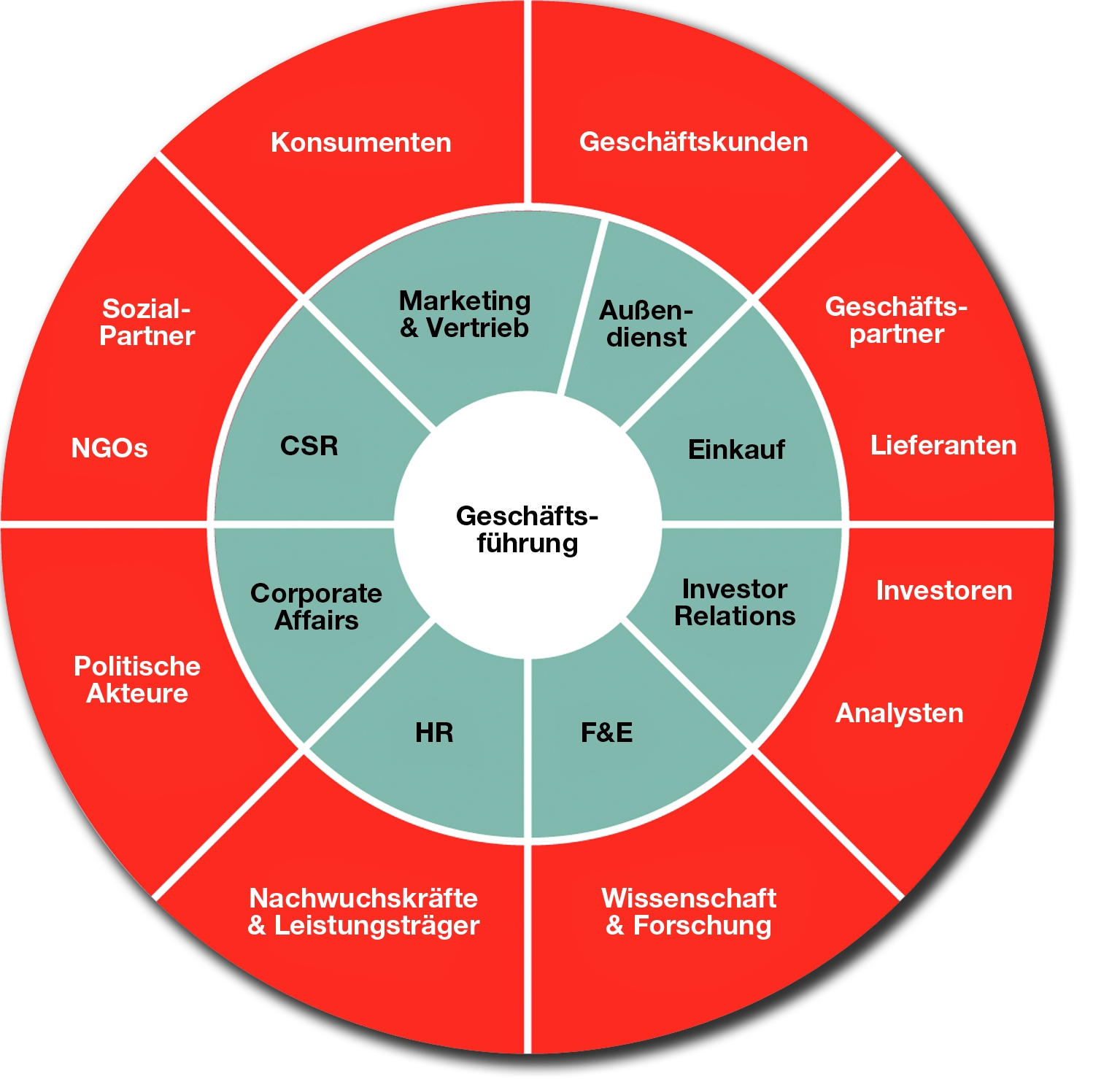
Die Beantwortung dieser Fragen liegt in der Verantwortung der Geschäftsführung. Dazu gehört die Klärung, welche Stakeholderbeziehungen strategische Bedeutung besitzen und welches Kooperationsverhalten jeweils angestrebt wird. Auf der operativen Ebene sind die Führungskräfte dafür verantwortlich, geeignete Rahmenbedingungen für das Beziehungsmanagement mit den relevanten Gruppen zu schaffen. Dessen Umsetzung ist dann Aufgabe jedes Mitglieds der Organisation in der jeweiligen Funktion: Marketing, Vertrieb und Außendienst pflegen den Kontakt mit den Kunden, der Einkauf steht in Beziehung zu den Lieferanten, Investor Relations zu den Kapitalgebern, die Personalabteilung zu potenziellen Mitarbeitern etc.

Image

Abb. 1: Kontaktstellen zwischen Unternehmen und Stakeholdern

Selbstorganisation ermöglichen

An dieser Stelle kommen erneut Komplexität und Volatilität des „New Normal“ ins Spiel. Unternehmen müssen ständig auf unvorhergesehene Ereignisse reagieren. Die dafür erforderlichen Entscheidungen schnell zu treffen und erfolgreich umzusetzen, wird zur Überlebensfrage. Traditionelle Organisationsmodelle, in denen Mitarbeiter festgelegte Aufgaben erfüllen und wenig Entscheidungsspielraum haben, fehlt die dafür nötige Flexibilität und Innovationsfähigkeit.

Der Trend zum Führen mit Zielen auf der Basis geteilter Wertvorstellungen scheint daher unaufhaltsam. Netzwerkorganisationen wenden die Prinzipien des Stakeholder-Managements auch intern an. Sie bauen auf das Interesse ihrer Mitglieder am gemeinsam zu schaffenden Mehrwert. Die primäre Aufgabe der Führungskräfte besteht dann nicht mehr darin, operative Entscheidungen zu treffen (Management 1. Ordnung). In den Vordergrund rückt ihre Fähigkeit zu erkennen, was einen Mitarbeiter motiviert, und diese Motivationen gezielt anzusprechen. Auf diesem Weg wird jedes Organisationsmitglied ermächtigt, im Rahmen einer vereinbarten Rolle eigenverantwortlich zu handeln. Voraussetzung dafür, dass die daraus resultierende Selbstorganisation tatsächlich den Unternehmenszielen dient, ist ein effektiver Strategieprozess auf der Basis von Management 2. Ordnung.

Strategie vermitteln

Strategie gilt als die Hohe Schule des Managements. Entsprechend gern und häufig wird das Wort verwendet; leider auch sehr frei, was die Bedeutung betrifft. Für manchen ist jeder Plan strategischer Natur. Seinen Ursprung hat der Begriff aber im Amt des Oberkommandierenden der athenischen Streitkräfte, in der Führung des Gefechts der verbundenen Waffen (Infanterie, Reiterie, Flotte), gegen einen Gegner, dessen Vorgehen im Verborgenen liegt. Um noch einmal Malik zu zitieren: „Strategie ist der Umgang mit einem nicht zu beseitigenden Mangel an Wissen“ – vulgo: Komplexität. Fehlt nur noch das „um zu“. Im Kontext der Organisation besteht der Zweck der Strategie darin, eine Gruppe von Menschen auf ein gemeinsames Ziel auszurichten.

Folglich lässt sich Strategie begreifen als Kunst, die Gegenwart aus der Zukunft zu entwickeln, indem man in Konstellationen auf der Basis ausgewählter Annahmen denkt. Dabei gilt es, zwischen mehr und weniger Erfolg versprechenden Konstellationen zu unterscheiden. Zur Strategie gehört aber nicht nur die Entscheidung für die voraussichtlich vorteilhafteste Alternative. Diese bleibt ein Muster ohne Wert, wenn es nicht gelingt, Menschen dafür zu gewinnen und dazu zu befähigen, diese Konstellation herbeizuführen und zu nutzen. Weshalb die Vermittlung der Strategie eine unverzichtbare Leistung jeglicher Führung ist.

Zielbild klären

Wenn Strategien nicht ans Ziel führen, dann hat meist ein Zielbild gefehlt, das für die erforderlichen Akteure verständlich, attraktiv und handhabbar war. Grund dafür kann mangelnde Konkretisierung sein, aber auch ein Überfluss an Details, unzureichende Anbindung an Werte und Kultur der Organisation oder fehlende Bezüge zwischen den Bausteinen der Strategie. Die Bedeutsamkeit hängt an der Erzählbarkeit, und dafür braucht es einen überzeugenden Plot. Einen roten Faden dafür bieten Herwig Friedag und Walter Schmidt in ihrem Buch Management 2.0: Kooperation (Freiburg 2009):

  1. Tragende Idee des Unternehmens: Woraus ziehen wir unsere Identität (Werte)? Wofür bzw. für wen sind wir da (Mission)? Was streben wir an (Vision)?
  2. Unternehmenspolitische Orientierung (UPO): Was ist die grundsätzliche operative Zielstellung? ( i.d.R. eine Finanz-Kennzahl, aber auch Aussagen zur Marke, zur Qualität als Arbeitgeber etc.)
  3. Zweckbestimmung: Entspricht die Daseinsberechtigung des Unternehmens der UPO oder ist diese Mission an die neue Unternehmenspolitische Orientierung anzupassen?
  4. Zentrale Herausforderung: Welches maßgebliche Problem ist zu lösen, um den Unternehmenszweck zu erfüllen? Welche Anspruchsgruppen, deren Unterstützung dafür erforderlich ist, sind von diesem Problem vor allem betroffen?
  5. Kern der Strategie: Wie lässt sich das Problem nachhaltig lösen? Welche Fähigkeiten sind zu entwickeln, um auf die Unwägbarkeiten der Zukunft besser reagieren zu können als der Wettbewerb?
  6. Geschäftsmodell: Welcher Kundentyp mit welchen Bedürfnissen soll künftig bedient werden? Worin besteht die Kernkompetenz des Unternehmens und muss sie eventuell ergänzt werden? Was macht das Angebot des Unternehmens einzigartig?
  7. Was ist jetzt zu tun: Welcher Zeitraum soll gestaltet werden? Was soll in diesem Zeitraum erreicht werden? Wie muss das Unternehmen dafür wahrgenommen werden? Woran soll erkannt werden, ob das Ziel erreicht ist?

Zusammenhänge zeigen

Ursache-Wirkungs-Beziehungen zwischen den im Strategieprozess erarbeiteten Perspektiven der relevanten Interessengruppen darzustellen, ist das Prinzip der Balanced Scorecard (BSC) von Robert Kaplan und David Norton. Die Praktikabilität dieses weit verbreiteten Instruments leidet, wenn die Anwender sich stärker an der Mechanik als an der Essenz der BSC orientieren. Wer sklavisch an den vier idealtypischen Perspektiven Finanzen, Kunden, Interne Prozesse sowie Lernen und Entwicklung festhält, wird es schwer haben, Kooperationspartner wie zum Beispiel Nichtregierungsorganisationen, Politiker oder Lieferanten einzubinden. Hinzu kommt das Problem, vielfältigere Bezüge aussagekräftiger darzustellen, als es die von Kaplan und Norton zur Lösung vorgeschlagene Strategy Map erlauben.

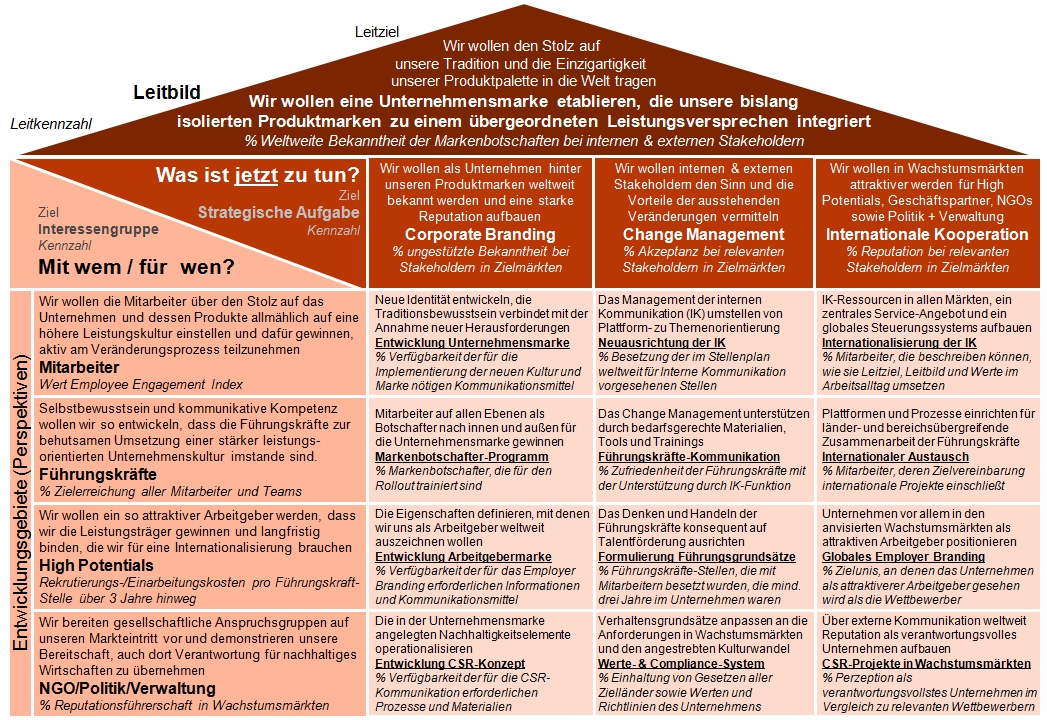
Eine handfestere Visualisierung emöglicht das 2000 von Friedag und Schmidt vorgestellte Strategische Haus der BSC. Dieses ganzheitliche Zielsystem bietet sowohl den strategischen Aufgaben als auch allen wichtigen Interessengruppen ein Dach und setzt beide Ebenen konkret in Beziehung zueinander.

Image

(Abb. 2: Das Strategische Haus der Kommunikation, © Internationaler Controller Verein)

Der Strategie ein Dach geben

Das Leitziel soll den Mitarbeitern veranschaulichen, was das Unternehmen erreichen will. Es muss sowohl mit den aktuell gelebten Unternehmenswerten als auch mit zweckorientiert angestrebten Veränderungen des Wertekatalogs vereinbar sein.

Das Leitbild zielt darauf, wie die relevanten Anspruchsgruppen das Unternehmen wahrnehmen sollen, um zum Erreichen des Leitziels beizutragen. Es dokumentiert die Alleinstellungsmerkmale und weckt so Erwartungen, die dann auch zu erfüllen sind.

Die Leitkennzahl legt fest, woran gemessen wird, ob das Unternehmen sein Leitziel erreicht hat. Sie definiert das oberste Kriterium, dem alle strategischen Entscheidungen unterworfen werden.

Strategische Aufgaben bestimmen

Die Strategischen Aufgaben werden in den Aufgängen des Hauses untergebracht. Sie bezeichnen die wesentlichen Anforderungen (Leistungen, Produkte, Veränderungen), denen sich ein Unternehmen zur Erreichung des Leitziels in dem zu gestaltenden Zeitraum widmen muss. Für jede formulierte Aufgabe sind ein Ziel zu definieren und eine Kennzahl zu bestimmen, an der die Zielerreichung gemessen werden soll. Damit die Organisation sich auf das Wesentliche konzentrieren kann, sind mehr als fünf Aufgaben nicht ratsam.

Erforderliche Mitwirkende benennen

Auf den Etagen des Strategischen Hauses ziehen die Stakeholder ein, die etwas Bestimmtes tun oder lassen sollten, damit das Unternehmen seinen Zweck erfüllen kann. Dabei geht es um die Frage, welche gemeinsamen Interessen zwischen der Organisation und den Anspruchsgruppen entwickelt werden sollen. Und es ist zu klären, wie die Motivationen der Interessenten angesprochen werden können, damit diese an der Erfüllung der strategischen Aufgaben mitwirken. Auch für jedes dieser Entwicklungsgebiete für gemeinsame Interessen wird ein messbares Ziel gesetzt.

Konkrete Aktionen entwickeln

Die Wohnungen des Hauses setzen die Stakeholder-Erwartungen in Beziehungen zu den strategischen Aufgaben der Organisation. An jeder Schnittstelle ist zu prüfen, ob das Thema für die fragliche Interessengruppe relevant ist. Wenn ja, beschreibt eine strategiezentrierte Aktion, wie die Anspruchsgruppe konkret angeregt werden soll, die Strategie des Unternehmens zu unterstützen.

Weil für jede Wohnung stets ein klares Ziel und eine Kennzahl definiert wird, an der die Ziellerreichung gemessen werden soll, entsteht ein verwobenes Zielsystem. Dieses Gesamtbild dient als Orientierunghilfe auf dem Weg durch das komplexe Gebäude der notwendigen Kooperationsbeziehungen. Es schafft die Voraussetzung dafür, Ziel und Weg einer Netzwerkorganisation zu erklären – gerade dann, wenn Unvorhergesehenes geschieht.

Strategie und Kommunikation praktisch verbinden

Das Strategische Haus hat sich als ideales Werkzeug für die Planung und Steuerung strategischer Kommunikation erwiesen. Es hilft nicht nur dabei, eine vermittelbare Strategie zu entwickeln, die den Interessen aller Kooperationspartner Rechnung trägt. Es ermöglicht darüber hinaus, im Rahmen der Mittelfristplanung die Anforderungen an die Unternehmenskommunikation strategiefokussiert zu definieren, daraus konkrete Leistungsbeiträge abzuleiten und deren Umsetzung funktionsübergreifend zu organisieren.

Walter Schmidt und der Autor dieses Beitrags haben die Praktikabilität des Strategischen Hauses für das Management der Unternehmenskommunikation anhand eines komplexen Praxisbeispiels überprüft. Aus der Dokumentation entstand das Erklärmodell des Fachkreises Kommunikations-Controlling im Internationalen Controller Verein (ICV). Interessierten Unternehmen bieten beide die Möglichkeit, im Rahmen einer Arbeitsgruppe unter ihrer Leitung eigene Erfahrungen mit dem ICV-Grundmodell für Kommunikations-Controlling zu sammeln.

Erschienen in >kommunikationsmanager (März 2012), S. 74-78. 

http://www.quadriga.eu/_files/2012-03-05_storck_strategiekommunikation_km_i-2012-1.pdf